
The Short Answer
A garage door that feels frozen to the ground in Hudson almost never means an actual ice buildup like you'd see further north. It usually means the rubber bottom seal has swollen with condensation and bonded itself to the concrete slab overnight, or the cold has thickened grease on the tracks and rollers enough that the opener is straining to move the door. Both are fixable in minutes once you know where to look. What you don't want to do is keep hitting the remote button — that's how you strip a gear, snap a cable, or bend a track trying to force a door that's simply stuck, not broken.
Symptoms Worth Paying Attention To
- The door won't lift at all, and the opener motor hums or clicks without movement.
- The door opens partway, then stalls or reverses on its own.
- A visible gap or tear line along the bottom seal where it pulled away from the slab.
- Grinding or stiff movement on the track, especially in the first few feet of travel.
- The safety sensors blink or refuse to align even though nothing touched them.
Cold mornings after a front pushes through — especially after a humid, rainy stretch — are when these symptoms show up most. The combination of overnight moisture and a temperature drop is what causes the trouble, not deep freezing temperatures.
Causes, in the Order a Technician Checks Them
1. Bottom Seal Stuck to the Slab
This is the first thing to rule out because it's the easiest fix. Humid air sits on a cool concrete floor overnight, and the vinyl or rubber seal along the bottom of the door can bond lightly to the slab, especially if the seal is older and starting to soften or swell from constant moisture exposure. A technician checks this by looking for a stretch mark or tear along the seal before touching the opener. The fix is usually a seal replacement if it's cracked, or in minor cases, breaking the bond gently by hand and letting the door run through a cycle or two.
2. Track Alignment and Roller Condition
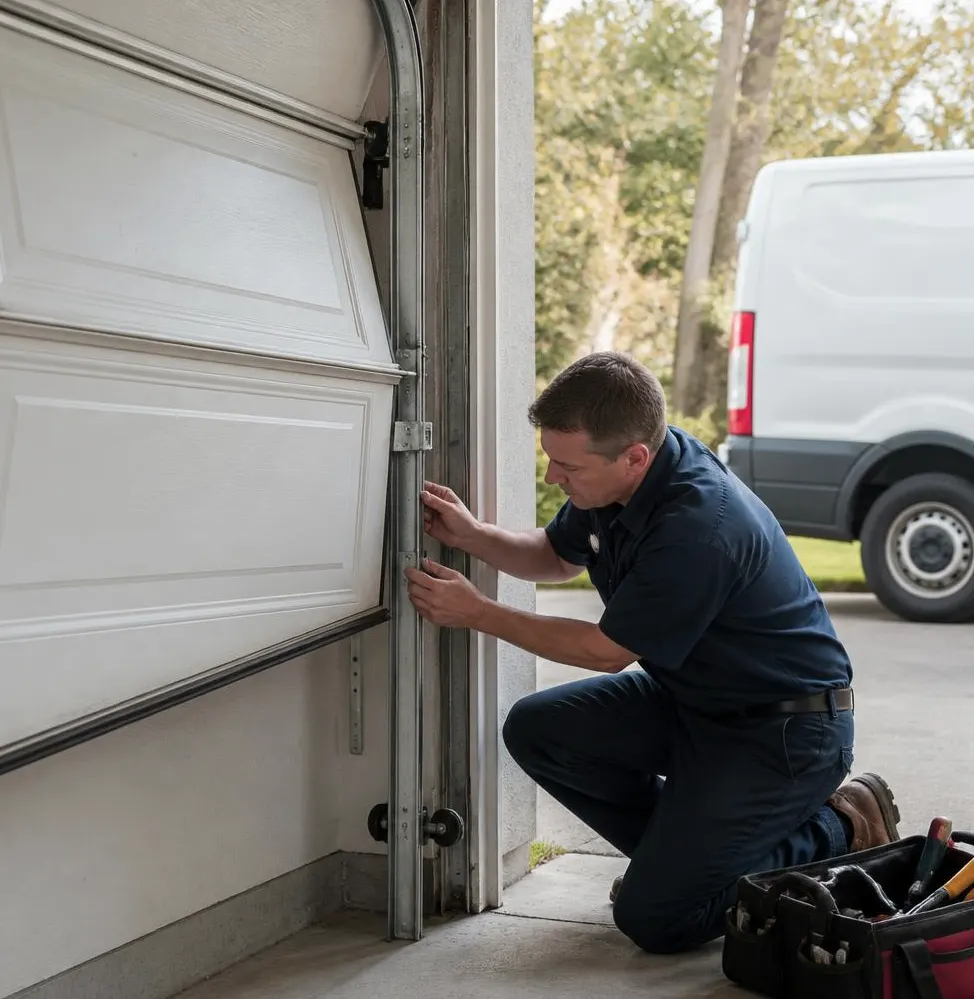
Next comes the track. Humidity swings cause metal tracks to expand and contract slightly, and over time that movement can nudge brackets out of alignment just enough to create drag. Rollers — especially older nylon ones — stiffen in cooler air and don't roll as freely. The check here involves running the door manually (disconnected from the opener) to feel for binding points. The fix is re-tightening track brackets, adjusting alignment, and replacing rollers that have gone stiff or cracked from years of moisture exposure.
3. Spring Tension
Torsion springs lose a small amount of tension as metal contracts in cooler temperatures, which is barely noticeable most of the year but becomes obvious on the one or two cold mornings when a door that normally lifts smoothly suddenly feels heavy. A technician checks balance by disconnecting the opener and lifting the door by hand — it should stay roughly where you leave it. If it drops or shoots up, the spring needs adjustment or, if it's already near the end of its cycle life, replacement. This is not a DIY repair; torsion springs are under enough tension to cause serious injury.
4. Opener Lubrication
Chain-drive and belt-drive openers both rely on lubricant at the rail and gears. Cooler, damp air thickens standard grease, which makes the motor work harder and can trigger the force sensors to stop the door mid-cycle, mistaking stiffness for an obstruction. The fix is cleaning off old, gummed-up lubricant and reapplying a garage-door-rated lithium or silicone lube rated for temperature swings — not household WD-40, which breaks down too fast in humid air.
5. Sensor Misalignment from Condensation
Last on the list, because it's the least common cause but easy to check: a thin film of condensation on the photo-eye sensors can make the door refuse to close or reverse unexpectedly. Wiping the lenses and confirming the sensors are pointed directly at each other usually resolves it.
When to Call Precision Garage Door of Hudson
If your door is sticking, stalling, or straining after a cold morning and a quick check of the seal and lubrication doesn't fix it, it's time to call in a technician rather than keep testing the opener's limits. Our Garage Door Tune-Up & Maintenance service covers exactly this — track alignment, roller condition, spring balance, and lubrication — so the door handles both humid Florida summers and the occasional cold snap without drama. If the door has already come off its track trying to force its way through, our Off Track Door Repair service gets it running safely again the same day.
Don't force a stuck door and risk a bigger repair. Call Precision Garage Door of Hudson and we'll have your garage door moving smoothly again, no matter what the Pasco County weather throws at it.