
The Moment You Notice It
You hit the button, the door starts down, and right before it touches the floor it stops and climbs back up. Or worse, it won't even start closing—it just sits there, or reverses the instant it begins. You try the remote. You try the wall button. Same result. Maybe you're standing in the garage watching this happen after an afternoon downpour, wondering if the storm had anything to do with it. In Hudson, it often does.
What You're Actually Seeing
There are two distinct symptoms here, and they usually point to different places:
- Closes partway, then reverses — the door gets most of the way down and kicks back up, sometimes with a visible jump or bounce.
- Won't close at all — you press the button and nothing happens when closing, though the door may open fine.
A technician checks the same handful of things for both, roughly in this order, because each one rules out the next.
1. The Photo-Eye Sensors
These are the two small sensors mounted a few inches off the floor on either side of the track, pointed at each other. If anything breaks that invisible beam—a box, a bike tire, a stray leaf blown in during a storm—the opener assumes something is in the doorway and refuses to close, or reverses mid-cycle.
In this climate, the more common culprit is moisture and grime rather than an actual obstruction. Humidity and afternoon rain leave a film on the lenses, condensation fogs them, and salt-laden air near the coast speeds up corrosion on the brackets, which lets them drift out of alignment. A tech checks for:
- A steady light on both sensors (one is usually solid, the other blinks when aligned correctly—check your opener's indicator pattern)
- Dirty or fogged lenses, wiped clean with a soft cloth
- Bent or loose brackets, often from a stray basketball, a car bumper, or just corrosion loosening the screws
- Sensors aimed slightly off from each other, even by a fraction of an inch
This fix is usually quick: clean the lenses, re-aim them so the indicator lights confirm alignment, and tighten the brackets. If the brackets are rusted through, they get replaced.
2. Something in the Track or on the Rail
Next, a technician runs the door and watches the track itself. Debris, a chunk of rust, or a buildup of grime can cause the door to bind right at the point it reverses. Humidity and moisture buildup inside the track—especially after weeks of storms—can also cause small amounts of surface rust that catch the rollers. Clearing the track and lubricating it with a garage-door-specific lubricant (not WD-40, which attracts dust) often solves intermittent reversing that happens at the same spot every time.
3. The Opener's Force and Limit Settings
Every opener has a setting that tells it how far to travel and how much resistance to tolerate before it assumes it's hit an obstruction and reverses. If these settings drift—which happens naturally over time, and faster in houses where humidity causes the door panels to swell slightly—the opener can misjudge where the floor is or how hard the door is pushing against the weatherstripping.
Adjusting these settings is a careful, incremental process. Set too sensitive, and the door reverses off a gust of wind or a stiff weatherstrip; set too loose, and the door won't stop for an actual obstruction, which is a real safety problem. This isn't a guess-and-check job—it takes someone who knows the opener model.
4. Rollers and Track Alignment
If the door still doesn't close smoothly, the technician checks whether the track itself has shifted or the rollers are worn. Houses in this area see a lot of expansion and contraction between hot, humid stretches and sudden storms, and that can nudge brackets loose or warp a track slightly over a few seasons. A door that's slightly off-track will drag at one point in its cycle, and the opener reads that drag as an obstruction and reverses. Realigning the track or replacing worn rollers usually resolves this.
5. Spring Tension
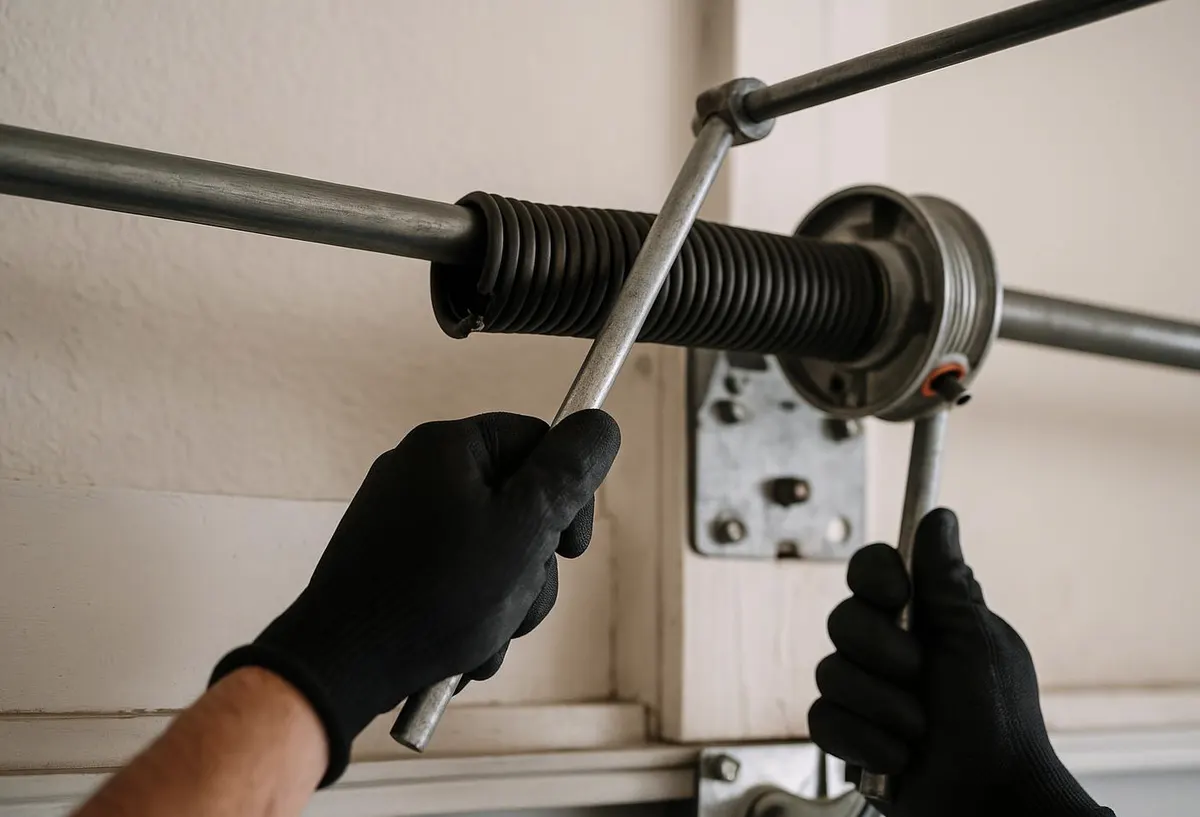
If the door is heavy to lift by hand (try this only with the opener disconnected) or the opener strains audibly as it moves the door, a worn spring is likely at fault. As springs lose tension, the opener has to work harder to lift and lower the door, and many openers interpret that extra strain as resistance and reverse to protect the motor and the door itself. This is one of the most common root causes behind a door that reverses consistently near the same point every cycle.
Spring replacement is not a DIY repair—these are under heavy tension and can cause serious injury. A technician replaces both springs as a pair, even if only one has failed, since the other is usually close behind.
6. The Opener's Logic Board
If none of the above explains it, the circuit board that controls timing, sensors, and force settings may be failing. Power surges from storms—common during hurricane season—can degrade these boards over time even if they don't cause an obvious outage. A failing board often shows other symptoms too: lights flickering, remote range dropping, or the opener running but ignoring commands. This usually means a board repair or a full opener replacement.
When to Call Precision Garage Door of Hudson
If cleaning the sensors and clearing the track doesn't fix it, or if the door is noticeably heavier than it used to be, it's time to call. We check the full list above in order, starting with the simple fixes and working toward springs or opener components only if that's where the problem actually lives. Our Garage Door Opener Installation and Garage Door Spring Repair services cover the two most common root causes we find on reversing doors in this area, and we'll tell you honestly which one you're dealing with before any work starts.
If your garage door in Hudson, FL is reversing, sticking, or won't close at all, call Precision Garage Door of Hudson today and we'll get it diagnosed and fixed right.